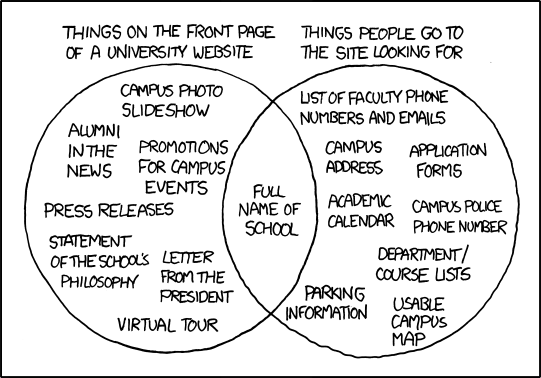
(Click here to find more online comics by this guy.)
Showing posts with label zblog. Show all posts
Monday, February 28, 2011
A little humor to start off your week
Since we're all in the full swing of the college search process (for juniors), I thought I would start off the week with a little humor that you might be able to relate to. I like some of this guy's stuff, while some of his cartoons are over my head (sort of like listening to Dennis Miller). I really appreciate this one because it validates that I'm not alone!
Wednesday, February 23, 2011
Colleges for Animal Lovers
Our society is becoming increasingly animal friendly. By now, it seems that most people consider pets to be part of the family, rather than mere property as was once the case. Consequently, it is becoming harder for some students to leave their pets to attend college away from home so some schools are responding by allowing animals in their dorm rooms!Animal-friendly dorms
The most well-known dog-friendly dorm system is at Eckerd College in Florida. (In order to avoid my usual long-windedness, I am going to just provide you with links to various programs instead of details about each one. Another Florida college that is recently gaining attention is Stetson, whose current president brought the policy with her from Stephens College in Missouri. There are a few other colleges as well, and you can find various lists by doing a websearch for "pet-friendly colleges" or something similar.
It's more common for colleges to allow cats in their dorms, as is the policy at big-brain schools MIT and CalTech. And many, many colleges allow aquariums, reptiles and small caged mammals in their rooms now. Just have your child check out their prospective colleges' "housing" or "residential life" pages.
Then there's Sweet Briar College in Virginia--you can't bring anything but an aquarium into your dorm room, but you can board your horse there!!
Animal-related clubs on campus
Below I've listed three examples of service-oriented animal-related clubs that would probably be of interest to young people who care deeply about animals and are seeking a means of associating with kindred spirits (not to mention some opportunities to snuggle with four-legged friends in the local area every once in a while):
Penn State (PA): Small and Exotic Animal Club
Becker College (MA): Animal Health Club (note: there is music on this homepage)
Lewis & Clark (OR): The Animal Club
If your son or daughter's first choice of college doesn't already have an animal-related club on campus, just remind them that every college has a procedure for starting new clubs and it's usually quite simple. Often, as few as five students can petition for club status, and then many schools will provide them with a meager budget to get started. Not only will this fix your child's desire for participating in such a club, but being the founder of this type of group will look fantastic on their résumé.
And last but not least...
Animal-related majors
Some people love animals so much that they want to devote their careers to their care and handling, and these students can pursue one of the animal-related majors offered at so many colleges these days. Their options include, but are not limited to:
- Veterinary medicine
- Veterinary technician school (often an associate's degree instead of a bachelor's degree)
- Zoology
- Animal science
- Wildlife management
- Livestock management
(There are also non-degree programs in animal training and grooming that might be appropriate for some students, especially those with special needs who won't be able successfully complete a university course of study.)
Two unique program that I would like to share with you are the Teaching Zoos at Santa Fe College in Florida (not New Mexico) and Moorpark College near Los Angeles. I'm not sure if there is anything else quite like them in the whole country. They are hard to gain admissions to because of the high demand, and their programs are very rigorous--demanding long hours and unwavering dedication to the animals in their care because this is what is required of zoo handlers in the real world.
Here is a link to the American Association of Zoo Keepers' webpage with some additional exotic animal training options.
I hope this article has helped eradicate any misconceptions that your son or daughter going away to college means they have to live without that all-important human-animal bond. We are fortunate to live in an era where society as a whole is beginning to realize how life sustaining and stabilizing the love of an animal truly is.
Monday, February 21, 2011
How's the Weather?
By now, seniors should have some decision letters rolling in, and I hope that some of them are acceptances. There are so many factors to consider in making your final choice--financial package, proximity to home, size, majors, reputation of the school, athletics. But there's one element many families overlook or underestimate that actually plays quite a big part in whether a student will stick out their time at a particular college: the weather. Or more specifically, how is the weather in relation to where they are living now?
Here is a chart I threw together for random colleges around the country:
It's very common for students from the west coast to want to go to the east coast and vice versa, but all too often, when weather hasn't been taken into consideration, they end up coming home early--sometimes after only one year (if not sooner). Kids from San Diego, West Palm Beach or Honolulu might think it's exciting to go to school in New York or Chicago, and indeed it is! But when the snow and wind kick in they're often ready to throw in the towel that very first winter, and then the family has to scramble to come up with a Plan B. Even areas with similar average precipitation rates can feel very different if a student is used to lots of rain but their new home has lots of snow instead, or if the humidity is significantly different.
A less-common problem, though not completely unheard of, is the student who enjoys the changing seasons (and perhaps the type of activities that accompany a good snowfall) and finds themself unhappy at a school in a year-round warmer, drier climate.
It's important to note the types of natural disasters that are common in each area, as well. Growing up with a pervasive threat of earthquakes is different than being used to an annual tornado or flood season. Some students adapt readily but for others, having one incident of an unfamiliar natural disaster near their college can send them packing. This is especially relevant since it seems that these events are happening with greater frequency and severity lately.
Also please consider whether your child shows symptoms of Seasonal Affective Disorder--a condition that causes people to sink into depression when they aren't exposed to enough sunlight on a regular basis.
There are so many things to consider when finding the "right match" for your child. I hope you will choose to include weather-related conditions on your list of criteria. It can only help to ensure that you are making the choice that will best set your child on the road to success.
Here is a chart I threw together for random colleges around the country:
| College | Avg Annual High | Avg Annual Low | Avg Precipitation |
| UCLA | 77 | 50 | ~17 inches |
| Evergreen (Olympia, WA) | 77 | 31 | ~51 inches |
| Trinity U (San Antonio, TX) | 95 | 37 | ~31 inches |
| Florida Atlantic (Boca Raton, FL) | 91 | 56 | ~60 inches |
| Univ of Connecticut | 78 | 16 | ~49 inches |
| Univ of Indianapolis | 85 | 17 | ~40 inches |
It's very common for students from the west coast to want to go to the east coast and vice versa, but all too often, when weather hasn't been taken into consideration, they end up coming home early--sometimes after only one year (if not sooner). Kids from San Diego, West Palm Beach or Honolulu might think it's exciting to go to school in New York or Chicago, and indeed it is! But when the snow and wind kick in they're often ready to throw in the towel that very first winter, and then the family has to scramble to come up with a Plan B. Even areas with similar average precipitation rates can feel very different if a student is used to lots of rain but their new home has lots of snow instead, or if the humidity is significantly different.A less-common problem, though not completely unheard of, is the student who enjoys the changing seasons (and perhaps the type of activities that accompany a good snowfall) and finds themself unhappy at a school in a year-round warmer, drier climate.
It's important to note the types of natural disasters that are common in each area, as well. Growing up with a pervasive threat of earthquakes is different than being used to an annual tornado or flood season. Some students adapt readily but for others, having one incident of an unfamiliar natural disaster near their college can send them packing. This is especially relevant since it seems that these events are happening with greater frequency and severity lately.
Also please consider whether your child shows symptoms of Seasonal Affective Disorder--a condition that causes people to sink into depression when they aren't exposed to enough sunlight on a regular basis.
There are so many things to consider when finding the "right match" for your child. I hope you will choose to include weather-related conditions on your list of criteria. It can only help to ensure that you are making the choice that will best set your child on the road to success.
Wednesday, December 22, 2010
Success Story: Zack R. (Part 1)
Every once in a while you meet a young(er) person who exemplifies all the things you hope are still alive in future generations: manners, ethics, ambition, humor, creativity, personal responsibility, healthy curiosity. Well, the gentleman I interviewed for today's post has all those bases covered, as well as some ephemeral attributes that I can't quite put words to.
Upon meeting Zack Rosenberg (a proudly self-proclaimed nerd) it is hard to imagine anything but the self-assured, friendly, successful persona he presents today. However, Zack's school years were not as smooth as one would wish for their precious little boy. He was diagnosed with OCD and Tourette Syndrome early on and as he aged into puberty and adolescence, his symptoms grew out of control.
He attended various schools in the Los Angeles area with minimal success, but eventually he had the great fortune of finding the solution: Glenholme School in Connecticut. (I encourage you to check out their website. Not only will you see an example of a best-practices secondary program, but you will be envious because odds are good that your high school wasn't this gorgeous and didn't incorporate an equestrian program.)
Zack was gracious enough to tell me about his experience of living away from home for the first time and what life has been like for him at the lovely Paul Smith's College--an even more gorgeous campus with another excellent, specialized program. (If nothing else, Zack has high aesthetic standards in living arrangements.)
Just to put his growth into perspective: Zack used to have literally debilitating tics and OCD symptoms; now he gives admissions presentations for his college and has interned two summers in a row at Marvel Comics in NYC.
Me: Hey Zack, thanks for letting me interview you. I want to help parents get some insight about what it's like for kids today to leave the safety of their families and how they can best adjust. Can you tell us about your experience moving away from home for the first time?
Zack: The move at the beginning was hard, but my family always reminded me that they were only a phone call away. I was only a junior in high school, remember. It would have been worse if it hadn't been for my mother urging me to keep busy. As I have come to realize, my transition was incredibly smooth due to my involvement with school activities. Whether it was participating in events or joining clubs, I kept myself busy. That way I had less time to over-think being away from home. So my suggestion for you parents is to encourage your child to get involved with campus life. Not only does it keep them busy, but that’s where they find their friends and people who have similar interests, and ultimately their support system.
Me: Even though you lived away from home for a couple years in high school, I'm sure the transition to dorm living was another change yet again because of the increased freedom. How would you describe dorm life?
Zack: Dorm life is dorm life. Everyone tells you to not succumb to peer pressure but that ain’t so easy. I just recommend you let your child find things out for themselves and live the college stuff. I found real-life experience, trial-and-error, to be a better deterrent than my parents telling me I couldn't do this or that. Personally I love dorm life, and now I am a Head Resident Assistant for 5 buildings on my campus! In the dorms I found a group of people that I now call my second family, and I am incredibly thankful for the chance to have lived with such a wondrous array of people.
(Continued on December 24th)
Upon meeting Zack Rosenberg (a proudly self-proclaimed nerd) it is hard to imagine anything but the self-assured, friendly, successful persona he presents today. However, Zack's school years were not as smooth as one would wish for their precious little boy. He was diagnosed with OCD and Tourette Syndrome early on and as he aged into puberty and adolescence, his symptoms grew out of control. He attended various schools in the Los Angeles area with minimal success, but eventually he had the great fortune of finding the solution: Glenholme School in Connecticut. (I encourage you to check out their website. Not only will you see an example of a best-practices secondary program, but you will be envious because odds are good that your high school wasn't this gorgeous and didn't incorporate an equestrian program.)
Zack was gracious enough to tell me about his experience of living away from home for the first time and what life has been like for him at the lovely Paul Smith's College--an even more gorgeous campus with another excellent, specialized program. (If nothing else, Zack has high aesthetic standards in living arrangements.)
Just to put his growth into perspective: Zack used to have literally debilitating tics and OCD symptoms; now he gives admissions presentations for his college and has interned two summers in a row at Marvel Comics in NYC.
Me: Hey Zack, thanks for letting me interview you. I want to help parents get some insight about what it's like for kids today to leave the safety of their families and how they can best adjust. Can you tell us about your experience moving away from home for the first time?
Zack: The move at the beginning was hard, but my family always reminded me that they were only a phone call away. I was only a junior in high school, remember. It would have been worse if it hadn't been for my mother urging me to keep busy. As I have come to realize, my transition was incredibly smooth due to my involvement with school activities. Whether it was participating in events or joining clubs, I kept myself busy. That way I had less time to over-think being away from home. So my suggestion for you parents is to encourage your child to get involved with campus life. Not only does it keep them busy, but that’s where they find their friends and people who have similar interests, and ultimately their support system.
Me: Even though you lived away from home for a couple years in high school, I'm sure the transition to dorm living was another change yet again because of the increased freedom. How would you describe dorm life?
Zack: Dorm life is dorm life. Everyone tells you to not succumb to peer pressure but that ain’t so easy. I just recommend you let your child find things out for themselves and live the college stuff. I found real-life experience, trial-and-error, to be a better deterrent than my parents telling me I couldn't do this or that. Personally I love dorm life, and now I am a Head Resident Assistant for 5 buildings on my campus! In the dorms I found a group of people that I now call my second family, and I am incredibly thankful for the chance to have lived with such a wondrous array of people.
(Continued on December 24th)
Wednesday, December 15, 2010
Various perspectives on ADD/ADHD (cont'd.)
In Monday's blog I touched on the basics of ADD/ADHD and introduced you to Amen Clinics, Inc. Today I'd like to bring you a few more perspectives before handing you off to other blogs and websites that dedicate themselves to this vast and topical subject.
The argument for "meds"?
I was trying to do some research here to find a group who categorically supports the use of Ritalin, Adderall and the like, and I couldn't find anything that wasn't either from a pharmaceutical company or associated with psychiatry. Let me make clear that I have great respect for psychiatrists because they have gone through an incomprehensible amount of rigorous schooling--more than I could handle--but in cases like this I think Maslow's sentiment applies: When all you've got is a hammer, everything starts to look like a nail. By this I mean that it seems like a foregone conclusion to ask a person who has built their career by prescribing medication whether or not medication should be prescribed.
On the other hand, I was able to find many, many groups who call for the elimination of or at least decrease in the use of ADHD medication with children and adolescents. They point to arguments such as the side effects and risks that many kids experience when taking the pills, the fact that it is really a "band-aid solution" because it treats some symptoms but not the underlying causes, the scandalous degree of over-diagnosis of ADHD, the fact that medicating kids sometimes robs them of developmental and personal growth opportunities, and on and on.
Personally, I have seen some kids who are absolutely crawling out of their own skin and have only been able to exist in the world thanks to the proper prescription of a psychostimulant. But for every one of those kids I have seen a dozen who are having their relatively "normal" curious, energetic behavior pathologized and medicated for the comfort and convenience of the adults in their life. Certainly there is a growing population of students who can't seem to function in our public school system without either medication or special services but it's disturbing how quickly our society reaches for that magic pill instead of trying to support those children in developing better self-awareness and coping mechanisms first.
The upside to ADD/ADHD

It might go against the grain to be positive about something that is so widely regarded as a "problem," but I truly believe there are beneficial aspects to an ADD/ADHD personality. Whether these abilities and traits are caused by ADD/ADHD or are simply co-occurring is irrelevant because they show up together so frequently that there is a definite correlation. What's more is that I'm not alone! A growing number of people are realizing that though ADD/ADHD symptoms can impair certain functions if not managed, there are some great characteristics that come from this way of being as well.
Here are some websites to check out if you want to delve into the "feel good" side of current ADD/ADHD conversation:
For general ADD/ADHD support on the web, try the following sites:
The argument for "meds"?
I was trying to do some research here to find a group who categorically supports the use of Ritalin, Adderall and the like, and I couldn't find anything that wasn't either from a pharmaceutical company or associated with psychiatry. Let me make clear that I have great respect for psychiatrists because they have gone through an incomprehensible amount of rigorous schooling--more than I could handle--but in cases like this I think Maslow's sentiment applies: When all you've got is a hammer, everything starts to look like a nail. By this I mean that it seems like a foregone conclusion to ask a person who has built their career by prescribing medication whether or not medication should be prescribed.
On the other hand, I was able to find many, many groups who call for the elimination of or at least decrease in the use of ADHD medication with children and adolescents. They point to arguments such as the side effects and risks that many kids experience when taking the pills, the fact that it is really a "band-aid solution" because it treats some symptoms but not the underlying causes, the scandalous degree of over-diagnosis of ADHD, the fact that medicating kids sometimes robs them of developmental and personal growth opportunities, and on and on.
Personally, I have seen some kids who are absolutely crawling out of their own skin and have only been able to exist in the world thanks to the proper prescription of a psychostimulant. But for every one of those kids I have seen a dozen who are having their relatively "normal" curious, energetic behavior pathologized and medicated for the comfort and convenience of the adults in their life. Certainly there is a growing population of students who can't seem to function in our public school system without either medication or special services but it's disturbing how quickly our society reaches for that magic pill instead of trying to support those children in developing better self-awareness and coping mechanisms first.
The upside to ADD/ADHD

It might go against the grain to be positive about something that is so widely regarded as a "problem," but I truly believe there are beneficial aspects to an ADD/ADHD personality. Whether these abilities and traits are caused by ADD/ADHD or are simply co-occurring is irrelevant because they show up together so frequently that there is a definite correlation. What's more is that I'm not alone! A growing number of people are realizing that though ADD/ADHD symptoms can impair certain functions if not managed, there are some great characteristics that come from this way of being as well.
Here are some websites to check out if you want to delve into the "feel good" side of current ADD/ADHD conversation:
- "Famous People with ADD/ADHD" by Kay Wittenhauer
- "Positive Aspects of ADHD and ADD" by Darcy Andries
- "Why You Should Hire Someone with ADHD" by Kathryn Goetzke
- "The Positives of ADD" by ADD Coach Pete Quily
- "ADHD Can Be a Good Thing" by Gabriella Roth
For general ADD/ADHD support on the web, try the following sites:
Wednesday, December 8, 2010
Try online classes for enrichment, résumé building or credit recovery
There are so many good reasons to consider online classes for your son or daughter while they are still in high school. My students use them most often for credit recovery (earning credits they missed in earlier grades) but they're also great for enrichment and building a stronger college application.Check out the online option if any of these conditions apply to your child:
- They lost credits/units from missing school for a prolonged period of time due to illness, severe anxiety, extended family travel, or any other circumstance.
- They earned a D or F in a class required for college eligibility.
- They are interested in studying an elective that isn't taught at their high school or local community college.
- They are motivated to try a new educational format and don't mind putting in extra work on top of their regular school day.
- They are current with credits/units but want to push ahead for a chance to graduate early.
Examples of Online Programs
BYU Independent Study is the program most widely used by my students. (Don't worry, there is no religious affiliation or content in their online classes.) They offer high school, university and even middle school courses. There is a cost associated with each class. Currently the high school level courses are $126 each, plus you have the option of having a paper manual mailed to you for $10 so you don't have to always read the material online or print it out at your own expense. Many classes require that you purchase textbooks in addition to the online postings. Assignments are submitted online, or by email, fax or mail.
Please note that most courses indicate there is a "proctored final." In order to receive credit for this course, your child must take the final in person somewhere with a certified BYU proctor or at a certified testing site. You can search for locations by zip code or you can have a counselor at their high school submit a Proctor Certification Form online.
Laurel Springs is another online school that my students have used, though less frequently. (It's not a comment on the quality of the program in any way, it's just much more expensive than BYU.) They call themselves "College Preparatory Distance Learning" and have high school, middle school and yes, even elementary school classes. They also require a one-time admissions fee of $100 (in addition to the $650 tuition per semester-long class) for students taking two or more classes while still enrolled in a traditional high school.
UCLA Extension does not offer basic high school classes for the purpose of recovering missed credits. Instead, this program is a great option for enrichment and studying advanced-level subjects that are seldom taught in high schools or even most community colleges. For example, how about your artistic child learning "AutoCAD for Landscape Design?" "Integrating a Green Business Strategy" or "Developing a New Business" for your entrepreneurial child? "Beginning Writing for the One-Hour Drama" for your screenwriter-to-be?
As you can see, there are a wide range of topics that appeal to adults and mature young adults. Two things to take note of, however. 1) Not all classes are online so be careful that the section you select is specifically labeled "online." 2) Since this is not a high school-level program, all students are expected to be able to read and write at a basic college level.
Finally, Kaplan Virtual Education is a new online school about which I know very little, but which seems to offer an interesting model of completing one's high school education entirely online. In much of the western U.S.--Arizona, California, Colorado, Idaho, Oregon and Washington--it appears that full-time enrollment is free. (Let me reiterate that I have no personal experience with this program yet.)
Whatever your reason for pursuing online classes for your child, be sure to do thorough research and communicate your plans to their current school. I hope this alternative educational channel piques their interest and opens up new possibilities for their future.
Subscribe to:
Posts (Atom)